· Buying Guides · 12 min read
Mixed Lots vs Sorted Lots: Which Stocklot Type Actually Fits Your Business?
Mixed, sorted, graded, or take-all — each stocklot type delivers a completely different buying experience. Here's the direct comparison, and why serious wholesale buyers gravitate toward sorted, single-programme lots every time.
What Is a Stock Lot? (Stocklot Meaning, Explained)
Before comparing lot types, it helps to establish what these terms actually mean — because they are used loosely across the industry, and imprecision costs buyers money.
Stock lots (also written as stocklots) refer to bulk quantities of finished goods — typically apparel — that are available for immediate purchase and shipment, outside of a made-to-order manufacturing process. The stock lots meaning in wholesale clothing specifically refers to inventory that already exists in a warehouse: garments that have been fully manufactured, quality-checked, packed, and are ready to ship without any production lead time.
The stocklot meaning is most precisely applied to factory overstock — finished goods that were produced for a specific retail buyer but never delivered, due to order cancellation, overproduction, or programme discontinuation. In common usage, however, “stocklot” and “stock lot” are applied broadly to any pre-existing bulk apparel inventory, including retail returns, graded seconds, and mixed unsorted lots.
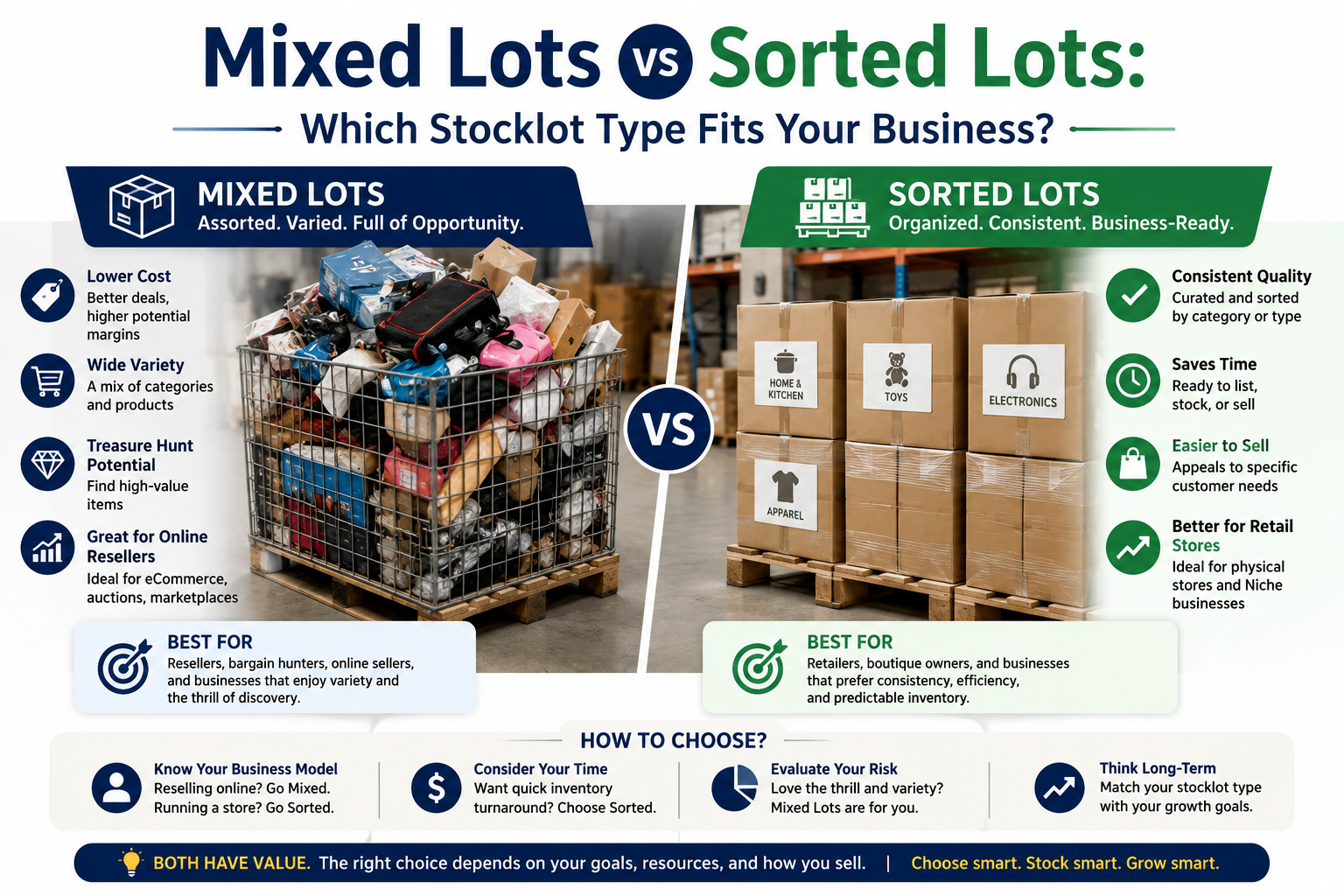
Mixed lots are a specific subset of the stock lot market: bulk inventory aggregated from multiple sources, sold by weight rather than by piece, with no guaranteed composition by category, size, or condition. The term “mixed lots” is sometimes used interchangeably with “stocklots” in lower-tier wholesale markets — but they are not the same thing, and the distinction has direct consequences for buyers.
Understanding these definitions is the foundation of every other sourcing decision in the stocklot market. A buyer who conflates stock lots with mixed lots, or assumes all stocklots are equivalent in quality and provenance, will consistently overpay for the wrong product.
Mixed Lots vs Sorted Lots: The Direct Answer
The question every new stocklot buyer asks — should I buy a mixed lot or a sorted lot? — has a cleaner answer than most suppliers will give you.
Mixed lots are cheaper per unit. Sorted lots are more profitable per unit. The difference is not the purchase price. It is everything that happens between acquisition and sale.
A mixed stocklot gives you a random assortment of categories, sizes, styles, and sometimes seasons — priced by weight, with no guaranteed composition. What you pay upfront is low. What you spend sorting, grading, and discarding unsellable units before you can sell anything is rarely calculated in advance, and almost always erodes the apparent cost advantage.
A sorted stocklot — specifically a single-programme, take-all factory overstock lot — gives you a known quantity of first-quality garments in a specific category, style, and size range, with full documentation. The per-unit acquisition price is higher than a mixed lot. The hidden costs are close to zero.
For buyers who resell through any channel where product consistency matters — online marketplaces, discount retail, export, or marketplace supply — sorted lots consistently outperform mixed lots on actual margin, not just headline price.
This is the framework that guides every lot we list at EcoStocklots: verified, single-programme factory overstock with full manifests, transparent condition disclosure, and no unsorted mixed-grade inventory. Our Grade A zero-defect stocklot collection represents the clearest example of what sorted, documented factory overstock looks like in practice — and why experienced bulk buyers return to this format repeatedly.
The Five Stocklot Types — What They Are and What They Actually Cost You
Not all stocklots are the same product. Understanding the differences between lot types is fundamental to making a sourcing decision that holds up once the container arrives.
Mixed lots (unsorted, priced by weight) are the entry point of the wholesale stocklot market in terms of headline cost — and the exit point in terms of actual profitability for most resale models. A mixed lot contains whatever the supplier has consolidated from multiple sources: different categories, different sizes, different conditions, often different seasons. You pay per kilogram, not per piece. The price looks attractive until you calculate what it costs to sort 2,000kg of mixed clothing into sellable categories, identify and remove unsellable units, and address the condition inconsistencies that appear in any mixed lot.
Mixed lots are not inherently bad sourcing. They serve a specific buyer profile: buyers with cheap warehouse labour, low-overhead sorting infrastructure, and a resale channel (local bulk markets, rag trade, export by weight) that does not require product consistency. For everyone outside that profile, the apparent cost advantage disappears quickly.
Sorted-by-category lots represent the next tier: the supplier has separated inventory by product type — tops, bottoms, outerwear, dresses — but has not sorted further by size, style, or condition. These lots remove the first layer of sorting work from the buyer but still require significant in-warehouse processing before the inventory is resale-ready. They suit buyers who have the infrastructure to handle size and style sorting but not the time or cost to start from completely unsorted mixed product.
Graded lots (A/B/C condition) are sorted by condition rather than by product type. Grade A is retail-ready with no visible defects. Grade B carries minor flaws — small marks, slight colour variation, minor stitching imperfections — that are still saleable in price-sensitive or secondary markets. Grade C is heavily flawed product suitable only for recycling, the rag trade, or upcycling. Graded lots require a supplier with credible, consistent grading standards — an inconsistent grader who calls Grade B product Grade A is one of the most common causes of buyer losses in the secondhand and returns market.
Style-specific lots are the cleaner end of the sorted market: a single style, in a range of sizes, in consistent condition. These appear most often in the returns and overstock market for buyers who need consistent SKU-level inventory for a specific product line. They require less post-purchase processing than any other mixed or sorted format, but they also require a clear understanding of the specific style’s market viability — because you are buying depth in a single product, not breadth across multiple ones.
Take-all factory overstock lots are the format that experienced bulk buyers prefer above all others — and the format that fundamentally differs from every other lot type on this list. A take-all lot is not a sorted, graded, or curated version of mixed inventory. It is a single, complete, first-quality programme of finished garments that were manufactured for a specific retail buyer, never delivered, and made available as a complete unit. Every piece in the lot was produced to the same specification, at the same factory, in the same production run. There is no sorting required. There is no grade assessment needed. The manifest tells you exactly what is in the lot because every unit in the lot is the same product.
The Real Cost Comparison: Mixed Lots vs Sorted Factory Overstock
The most persistent misconception in wholesale stocklot buying is that mixed lot pricing represents better value than sorted lot pricing. It does not — for most buyers, in most resale contexts. Here is the cost comparison that changes that perception.
Hidden costs in mixed lots that buyers rarely calculate upfront:
Sorting labour is the largest and most consistently underestimated cost. A 2,000-unit mixed lot requires someone to physically handle every piece: identify category, assess condition, sort by size where possible, and separate unsellable units. At a realistic labour rate, this cost often adds €0.30–€0.80 per unit to the landed cost — before you have sold anything.
Unsellable unit rate is the second hidden cost. In any mixed lot, a percentage of units will be in condition that makes them unsellable in your primary channel. In a well-graded mixed lot this might be 5–10%. In a poorly sourced or disclosed mixed lot it can reach 20–30%. These units represent pure cost with no revenue — effectively a tax on the headline per-unit price that is never disclosed by the supplier.
Assortment risk is the third factor. A mixed lot buyer cannot predict what they will receive in sufficient detail to plan resale before the goods arrive. Channel preparation, photography, listing creation, and retail floor planning all require known inventory. Mixed lot buying delays all of these by the time it takes to sort the incoming goods.
What sorted factory overstock eliminates:
A single-programme take-all factory overstock lot has no sorting cost, because the inventory is already sorted by the production process itself. Every unit is the same product. There is no unsellable unit rate, because the lot is first-quality, defect-free factory output — not a mixed collection of returns and surplus from multiple sources. There is no assortment risk, because the full manifest is available before purchase: style, colour, size breakdown, unit count, and condition are all documented and disclosed.
The per-unit acquisition price of a sorted factory overstock lot is higher than a mixed lot. The per-unit total cost — including all post-purchase processing, unsellable unit write-off, and opportunity cost of delayed resale — is consistently lower.
Which Lot Type Matches Which Buyer Profile
The right lot type is not determined by which format sounds better in theory. It is determined by your specific resale infrastructure, channel requirements, and tolerance for post-purchase processing.
Mixed lots suit buyers who have: cheap warehouse sorting labour, a resale channel that does not require product consistency (bulk local markets, rag trade, export by weight), and the cash flow to absorb delayed revenue while inventory is processed. They do not suit online resellers, discount retailers, or export buyers who need documented, consistent product.
Sorted-by-category lots suit buyers who have: some sorting infrastructure and the need for category-specific inventory, but insufficient volume or budget to access take-all factory overstock lots in single categories. A stepping stone format, not a destination.
Graded lots suit buyers who have: a returns or secondhand resale model where condition grading is central to the product proposition — online secondhand platforms, charity retail supply, grade-specific export channels. They are only as good as the supplier’s grading consistency, which is the critical variable to verify.
Take-all factory overstock lots suit buyers who have: the capacity to absorb a full programme lot (typically 3,000–20,000+ units), a resale channel that values product consistency and documentation, and an understanding that the higher per-unit price is offset by near-zero post-purchase processing cost. This is the format used by the most experienced and most profitable stocklot buyers in the market.
At EcoStocklots, every lot we list is the take-all factory overstock format. We do not mix grades, aggregate from multiple sources, or sell unsorted mixed product. Our Grade A zero-defect stocklot inventory is updated regularly with single-programme, first-quality factory overstock across all apparel categories — with full manifests, transparent size ratio disclosure, and original factory tags intact.
What the Documentation Should Tell You Before You Buy
One of the clearest practical differences between mixed lots and sorted factory overstock is the documentation that a legitimate supplier can provide before purchase — and what the absence of documentation tells you about the lot.
A mixed lot typically comes with a weight-based commercial invoice and a general description of contents. It cannot come with a detailed packing list because the contents are, by definition, not sorted to that level of specificity. This is not a documentation failure — it is an inherent property of the product type.
A genuine take-all factory overstock lot comes with a complete commercial invoice itemised by style, colour, size, and unit count; a packing list matched to actual carton contents; a certificate of origin; and original garment care and content labels. It can come with this documentation because every unit in the lot is the same product, manufactured in the same run, packed to the same specification.
The documentation is not just a compliance requirement. It is a sourcing intelligence tool. A full manifest tells you whether the size ratio is usable in your market before you commit. It tells you whether the colour mix suits your resale channel. It tells you whether the style is appropriate for your buyer. Mixed lot buyers make these assessments after the goods arrive. Sorted factory overstock buyers make them before.
How to Evaluate Any Stocklot Before Committing
Whether you are evaluating a mixed lot or a sorted factory overstock lot, the due diligence framework is consistent — but the answers you get will be very different depending on the lot type.
Provenance. Where did the lot come from, and why is it available? A take-all factory overstock lot has a clear answer: manufactured for a specific buyer, programme cancelled, available for clearance. A mixed lot often cannot give you a clear answer, because the inventory has been aggregated from multiple sources with different histories.
Condition disclosure. Is the condition stated clearly and in writing? First-quality, defect-free factory overstock is a specific claim. “Mixed condition” or “various grades” is not. Any lot where condition is not explicitly and clearly disclosed before purchase carries condition risk that is not reflected in the per-unit price.
Full manifest. Can the supplier provide a style-by-style, size-by-size manifest before you commit? If not, you are buying unknown inventory. For any resale channel that requires product planning, unknown inventory is a liability, not an opportunity.
Video inspection. For any purchase above your risk threshold, request a live video inspection of the actual lot — the physical goods, in their actual location, showing the condition and composition of a representative sample. Legitimate suppliers offer this as standard practice. It should not be a difficult or unusual request.
EcoStocklots: Sorted Factory Overstock, Every Time
At EcoStocklots, we made a deliberate decision at the start: we list only take-all, single-programme factory overstock. No mixed lots. No unsorted grade aggregations. No manufactured-to-order inventory dressed up as genuine overstock.
Every lot in our inventory is sourced directly from factory surplus — cancelled retail programmes and overproduction clearance with full documentation, original tags, and transparent manifest disclosure. The per-unit price is not the lowest in the market. The total cost of acquisition, including everything that happens between purchase and first sale, consistently is.
Our Grade A zero-defect stocklot collection spans all apparel categories — tops, bottoms, outerwear, dresses, knitwear, and more — updated regularly as new factory overstock lots become available. Every lot ships with full export documentation and is available for live video inspection before purchase.
Browse current Grade A zero-defect factory overstock inventory → View Grade A Zero-Defect Stocklots
Real-time inspection available: We provide live video inspections via WhatsApp for any current inventory lot. Chat with our sourcing team.
EcoStocklots is a B2B wholesale platform specialising in factory overstock apparel clearance. We connect global importers, discount retailers, and online resellers with verified, defect-free surplus inventory at competitive bulk pricing.