· Buying Guides · 8 min read
Clothing Stocklot Quality Control: The B2B Inspection Checklist for Grade A Apparel
Grade A stocklot or mixed-grade risk? Before you commit capital to any bulk apparel purchase, here's the 5-point inspection checklist experienced buyers run — and what failing any one of them actually costs you.
What Is Grade A Stocklot? (And Why It’s the Only Standard That Protects Your Margin)
Clothing stocklot quality control starts with one definition that every bulk apparel buyer needs to internalise before placing any order: what Grade A actually means — and what it does not.
A Grade A stocklot is factory-fresh, defect-free inventory sourced from cancelled purchase orders or overproduction programmes. Every unit in a genuine Grade A lot was manufactured to a retail buyer’s specification, passed factory QC before packing, and carries original tags. It has never been worn, returned, or sorted from a mixed-condition batch. It is retail-ready the moment it arrives at your warehouse.
This is not the same as a supplier telling you a lot is “good quality.” It is not the same as a lot described as “mostly Grade A.” In apparel stocklot inspection terms, Grade A is a binary standard: every unit meets it, or the lot is not Grade A.
The five variables that determine whether a clothing stocklot is genuinely Grade A:
- Fabric consistency — GSM matches original spec, no pilling, no dead-stock odour
- Size ratio integrity — usable distribution across the full size run, not surplus in extremes
- Stitching and seam quality — clean overlock throughout, no loose threads in high-stress areas
- Labelling compliance — original tags intact, or de-branded with full disclosure before purchase
- Packaging condition — individually poly-bagged, moisture-protected, retail-ready on arrival
Each of these is a pass/fail checkpoint. A lot that fails one is not a Grade A stocklot with a minor issue. It is a mixed-grade lot priced as Grade A — and the difference in resale outcome is not minor.
At EcoStocklots, every lot we list undergoes mandatory pre-listing inspection against all five checkpoints before it is made available to buyers. No self-certified Grade A claims. No mixed-grade lots listed without explicit disclosure.
Browse current Grade A zero-defect stocklot inventory → View Grade A Stocklots
Why Clothing Stocklot Quality Control Fails — And Where the Loss Actually Shows Up
Most apparel stocklot inspection failures do not announce themselves at the point of purchase. They show up three weeks later, when the container opens and the sorting begins. By that point, the buyer has already paid the per-unit price, the freight, the import duty, and the warehousing cost. Every defective unit is pure loss — there is no return, no refund, and no recourse against a supplier who disclosed nothing in writing.
Understanding where clothing stocklot quality control breaks down — and at which stage — is the most practical risk management tool available to bulk apparel buyers.
The most common failure points, in order of frequency:
Condition misrepresentation is the leading cause of stocklot buyer losses. A supplier describes a lot as Grade A factory overstock. The goods arrive as a mix of first-quality units, retail returns, and grade-B seconds sorted together and poly-bagged uniformly. The buyer has no visual way to distinguish them in transit. The first indication of the problem is the return rate from their resale customers.
Size ratio distortion is the second most common issue. Overstock lots frequently carry surplus in the extreme sizes — XS and 3XL — because those sizes moved most slowly at retail before the programme was cancelled. A lot manifest that shows balanced totals across the size range can still be heavily distorted within those totals. Always request a carton-by-carton breakdown, not just aggregate size counts.
Fabric degradation from dead-stock storage is less common but disproportionately damaging when it occurs. Cotton knits stored in humid warehouse conditions for extended periods develop a characteristic odour that does not wash out in a single cycle and generates immediate consumer complaints. GSM loss from compression storage affects the handfeel and drape of woven garments in ways that are not visible in product photography.
Labelling non-compliance creates customs and legal exposure that most buyers do not factor into their risk calculation. Some factory overstock lots carry original brand tags from a programme that was discontinued specifically because the brand did not want the product reaching market. Importing and reselling these units without removing or replacing the tags creates intellectual property liability that has nothing to do with the garment’s physical condition.
The 5-Point Apparel Stocklot Inspection Checklist
This is the framework that experienced clothing stocklot quality control buyers apply to every lot before committing. Each point is a pass/fail gate — not a sliding scale.
1. Fabric Consistency and GSM Verification
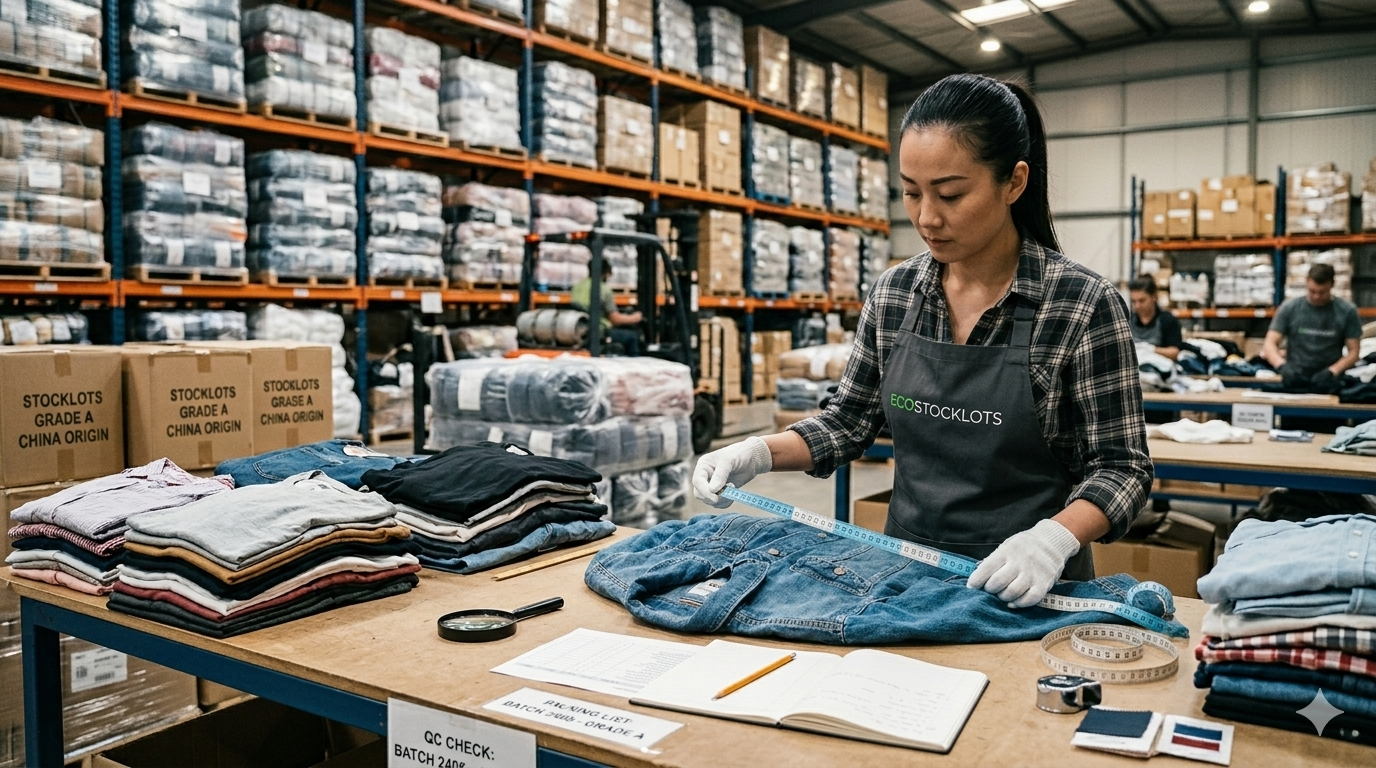
Pull a representative sample from multiple cartons — not just the top layer of a single carton. Check fabric weight against the stated GSM. For cotton knits, the hand-feel should be consistent across units: uniform weight, uniform texture, no surface pilling on unworn garments. Hold units to light and check for uneven dye coverage, particularly in solid-colour lots where variation is most visible. In a genuine Grade A stocklot, fabric consistency is a given. Any variation across units is a signal that the lot has been consolidated from multiple production runs — which is not the definition of a single-programme factory overstock lot.
2. Size Ratio Integrity
Request the full packing list before purchase — itemised by carton, by style, by colour, and by size. The ideal commercial size ratio for most markets is approximately 1:2:2:1 (S:M:L:XL), with the exact distribution varying by category and target geography. Flag any lot where more than 30% of units sit in the two smallest or two largest sizes. For a stocklot you intend to move through a single resale channel, a distorted size ratio is not an inconvenience — it is a guaranteed write-off on the extreme sizes, which must be factored into your per-unit economics before purchase, not after delivery.
3. Stitching and Seam Integrity
Turn the garment inside out. On a genuine Grade A stocklot garment, overlock stitching should be tight, consistent, and unbroken across all seams. Check high-stress points specifically: armhole seams, crotch seams, waistband joins, and pocket attachment points. These are the locations where sub-standard stitching fails first under consumer wear — and the locations that generate the most returns when apparel stocklot inspection is skipped. Loose threads on unworn garments indicate either rushed production finishing or inadequate pre-packing QC, neither of which is consistent with genuine Grade A factory overstock.
4. Branding and Labelling Compliance
Confirm in writing — before purchase — whether the lot carries original brand hangtags and care labels, or whether it is cut-label product with brand identifiers removed. Both can be legitimate; the issue is undisclosed mixing. A lot that contains both tagged and cut-label units without prior disclosure has been misrepresented. Beyond brand tags, verify that care labels carry the required fibre content and country of origin information for your import market — EU, UK, US, Australian, and Gulf Cooperation Council markets all have specific labelling requirements for imported apparel, and non-compliant labels create customs clearance complications that add cost regardless of the garment’s physical quality.
5. Packaging Condition
Every unit in a retail-ready Grade A stocklot should be individually poly-bagged. The poly-bag protects against moisture ingress during sea freight (particularly relevant for FCL shipments on long-haul routes), dust accumulation in warehouse storage, and physical contact damage during container loading. Inspect poly-bag integrity across multiple cartons — punctured or open bags in a significant proportion of units indicate inadequate packing or rough handling post-QC, and the units inside should be individually re-inspected. Retail-ready means the garment can move from your warehouse to a retail floor or a marketplace listing without any additional processing cost on your end.
How to Verify Quality Before You Transfer Payment
The apparel stocklot inspection framework above describes what to check. This section covers how to check it when you cannot physically be at the factory or warehouse.
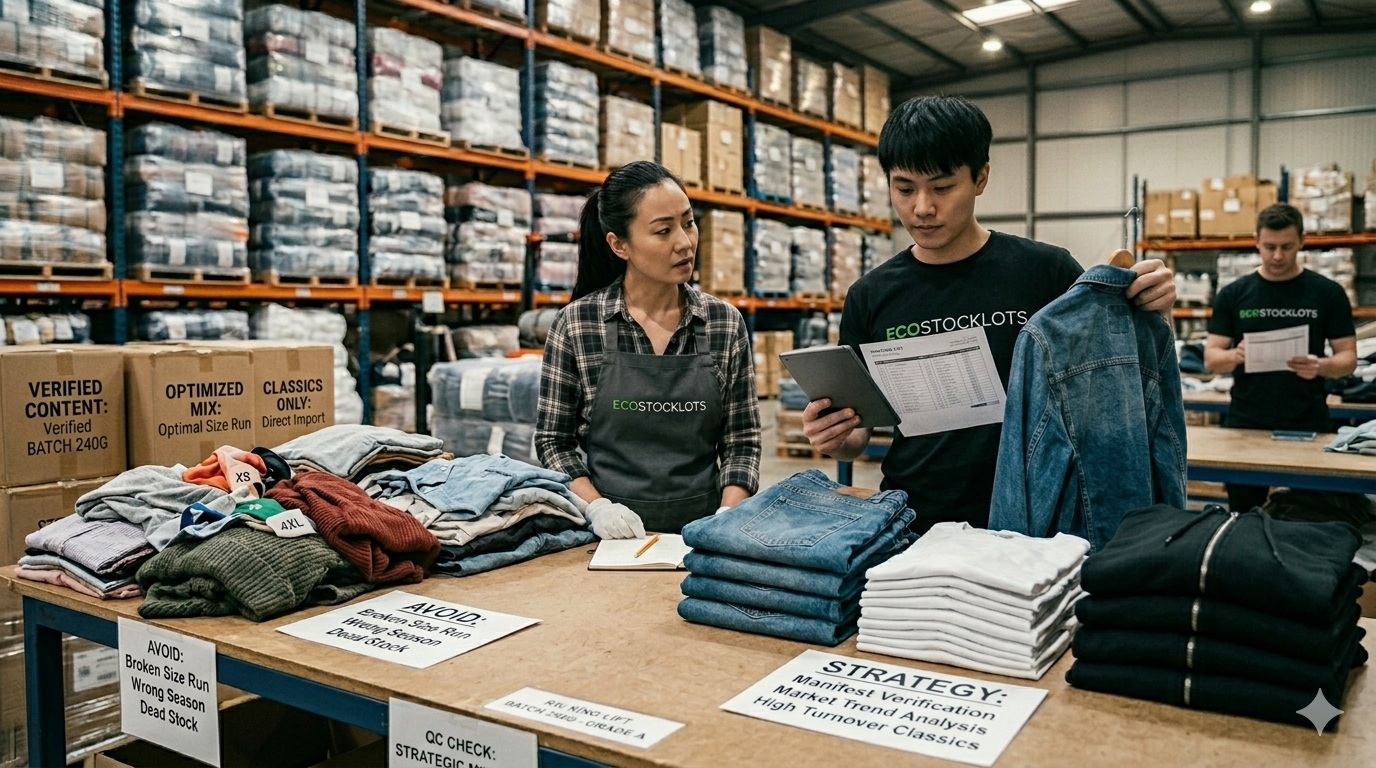
Request a live video inspection. A legitimate clothing stocklot quality control supplier will offer real-time WhatsApp video inspection of the actual lot — not stock footage, not product photography from a previous production run. During a live inspection, ask the supplier to open random cartons from different positions in the stack, turn garments inside out on camera, show you the size labels across multiple units, and hold garments to light for fabric consistency checks. If a supplier declines or delays a video inspection request, that response is itself meaningful information.
Cross-reference the manifest against what you see. During any video inspection, ask the supplier to show you the carton labels and confirm they match the packing list you have been provided. Discrepancies between the manifest and the physical carton contents are the clearest indicator of a lot that has been consolidated or manipulated post-production.
Request written condition confirmation. Before any payment transfer, obtain written confirmation — in the commercial invoice or a separate supplier declaration — that the lot is first-quality, defect-free, Grade A factory overstock. A supplier unwilling to confirm this in writing is communicating something important about the lot’s actual condition.
EcoStocklots: Grade A Stocklot, Pre-Inspected Before Listing
At EcoStocklots, every lot in our inventory is sourced directly from factory overstock — genuine cancelled-order or overproduction clearance — and undergoes mandatory pre-listing inspection against all five checkpoints above before it is made available to buyers.
We do not list mixed-grade lots as Grade A. We do not aggregate from multiple production sources without disclosure. Every lot ships with a full manifest, original factory tags intact, complete export documentation, and transparent size ratio breakdown — so you know exactly what you are buying before you commit.
Browse current Grade A zero-defect stocklot inventory → View Grade A Stocklots
Real-time inspection available: We provide live video inspections via WhatsApp for any current inventory lot. Chat with our QC team.
EcoStocklots is a B2B wholesale platform specialising in factory overstock apparel clearance. We connect global importers, discount retailers, and online resellers with verified, defect-free surplus inventory at competitive bulk pricing.